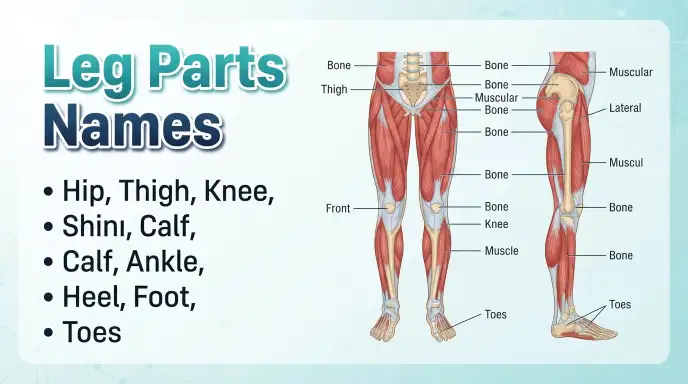
The main leg parts names include the thigh, knee, shin, calf, ankle, heel, sole, and toes. Each part plays an important role in helping the body stand, walk, run, bend, and maintain balance. Learning the names of the leg parts makes it easier to understand human anatomy, identify muscles and bones, and describe different areas of the lower body.
What Are the Main Parts of the Leg?
The human lower limb contains several connected parts, including bones, muscles, joints, and soft tissues. Each part has a specific structure and function.
Here are the main leg parts names:
- Thigh: The upper part of the leg, between the hip and knee.
- Knee: The joint that allows the leg to bend and straighten.
- Kneecap: The small bone at the front of the knee.
- Shin: The front portion of the lower leg.
- Calf: The muscular area at the back of the lower leg.
- Ankle: The joint connecting the lower leg to the foot.
- Heel: The back part of the foot.
- Sole: The bottom surface of the foot.
- Toes: The five digits at the end of each foot.
In everyday conversation, people often use the word “leg” for the entire lower limb, from the hip to the toes. In anatomical terminology, however, the leg refers specifically to the area between the knee and ankle.
Upper Leg Parts Names
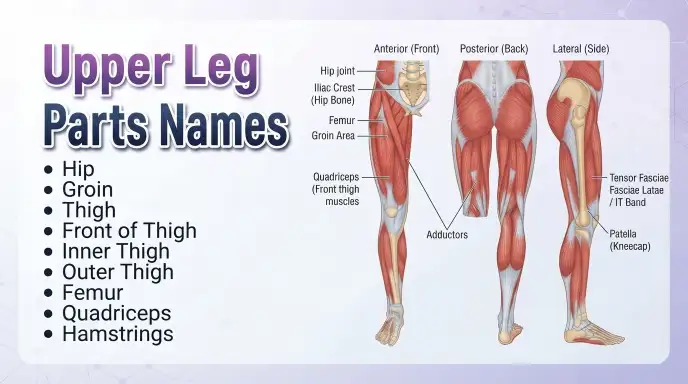
The upper leg extends from the hip to the knee. It contains the femur, the largest bone in the human body, along with several important muscle groups.
1. Thigh
The thigh is the broad area between the hip and knee. It contains powerful muscles that help you walk, climb stairs, jump, and stand up from a seated position.
The femur supports much of the body’s weight and connects the hip joint to the knee joint.
2. Front Thigh
The front of the thigh contains the quadriceps muscle group. These muscles help straighten the knee and support movements such as walking, running, and kicking.
3. Back Thigh
The back of the thigh contains the hamstring muscles. They help bend the knee and move the thigh backward at the hip.
4. Inner Thigh
The inner thigh contains the adductor muscles. These muscles help bring the legs toward the body’s midline and stabilize the hips during movement.
5. Outer Thigh
The outer thigh includes muscles and connective tissues that support hip movement and stability. The iliotibial band, a strong strip of connective tissue, runs along the outside of the thigh.
Knee Parts Names
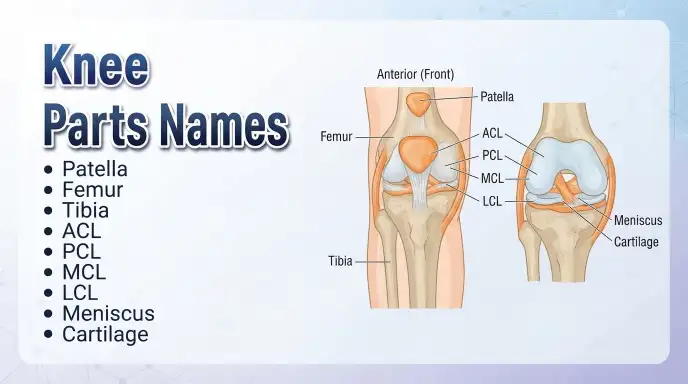
The knee connects the thigh to the lower leg. It is one of the body’s largest joints and supports many everyday movements.
1. Kneecap (Patella)
The patella is the small, flat bone at the front of the knee. It protects the joint and helps the quadriceps muscles straighten the leg efficiently.
2. Knee Joint
The knee joint connects the femur to the tibia. It allows the knee to bend and straighten while supporting body weight.
3. Meniscus
The knee contains two crescent shaped pieces of cartilage called menisci. They help distribute pressure and absorb shock between the thighbone and shinbone.
4. Ligaments
Ligaments connect bones and help stabilize the knee. The anterior cruciate ligament (ACL), posterior cruciate ligament (PCL), medial collateral ligament (MCL), and lateral collateral ligament (LCL) help control knee movement.
5. Back of the Knee
The hollow area behind the knee is called the popliteal fossa. Blood vessels, nerves, and other structures pass through this region.
Lower Leg Parts Names
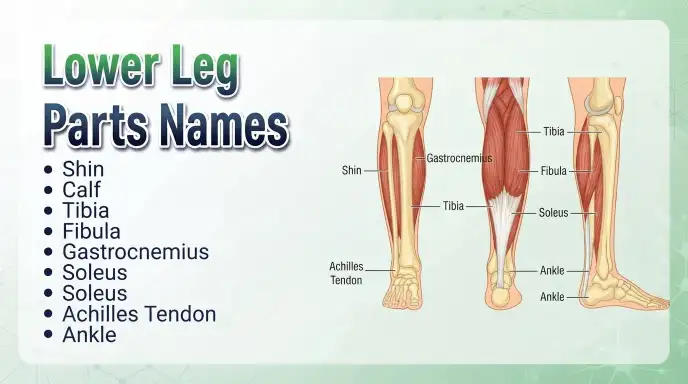
The lower leg extends from the knee to the ankle. It contains two bones, several muscles, and important tendons that support movement.
1. Shin
The shin is the front part of the lower leg. The tibia, also known as the shinbone, forms its main bony structure and carries much of the body’s weight.
2. Calf
The calf is the muscular area at the back of the lower leg. Its main muscles, the gastrocnemius and soleus, help push the foot downward when walking, running, or standing on your toes.
3. Outer Lower Leg
The fibula is the thinner bone that runs along the outer side of the lower leg. It provides muscle attachment points and contributes to ankle stability.
4. Front Lower Leg Muscles
The tibialis anterior muscle runs along the front of the lower leg. It helps lift the foot and toes toward the shin, a movement called dorsiflexion.
5. Achilles Tendon
The Achilles tendon connects the calf muscles to the heel bone. It plays an important role in walking, running, jumping, and pushing off the ground.
Ankle Parts Names
The ankle connects the lower leg to the foot. It supports body weight and allows the foot to move up, down, and through other controlled movements.
- Medial malleolus: The bony bump on the inner side of the ankle, formed by the tibia.
- Lateral malleolus: The bony bump on the outer side of the ankle, formed by the fibula.
- Ankle joint: The joint that allows the foot to move up and down.
- Ankle ligaments: Strong bands of tissue that connect bones and help stabilize the joint.
- Achilles tendon: The tendon at the back of the ankle that connects the calf muscles to the heel.
The ankle also works with the foot’s smaller joints to maintain balance on uneven surfaces.
Foot Parts Names
The foot supports the body’s weight and helps maintain balance during standing and movement. It contains 26 bones, numerous joints, muscles, ligaments, and tendons.
1. Heel
The heel forms the back part of the foot. The heel bone, called the calcaneus, is the largest bone in the foot and helps absorb impact during walking.
2. Sole
The sole is the bottom surface of the foot. It includes protective skin, cushioning tissues, and structures that support body weight.
3. Arch
The arch is the curved structure along the bottom of the foot. It helps distribute body weight and absorb forces during movement.
4. Ball of the Foot
The ball of the foot is the padded area behind the toes. It helps support weight and provides leverage when you push off the ground.
5. Toes
Each foot has five toes. The big toe is the largest and plays an important role in balance and forward movement.
6. Top of the Foot
The top of the foot is called the dorsum. It contains tendons, blood vessels, and other structures that support foot movement.
7. Instep
The instep refers to the raised middle portion of the foot, particularly the area around the arch on the upper side.
Names of the Main Leg Bones
The bones of the lower limb provide support, protect important structures, and work with muscles to produce movement.
| Bone name | Location | Main function |
| Femur | Thigh | Supports body weight and helps move the hip and knee |
| Patella | Front of knee | Protects the knee and improves muscle leverage |
| Tibia | Inner side of lower leg | Carries most of the lower leg’s weight |
| Fibula | Outer side of lower leg | Supports ankle stability and provides muscle attachment |
| Talus | Upper part of foot, below the ankle | Transfers weight between the leg and foot |
| Calcaneus | Heel | Supports the heel and helps absorb impact |
| Tarsals | Rear and middle foot | Form the ankle and rear foot region |
| Metatarsals | Middle of foot | Support the foot and connect to the toes |
| Phalanges | Toes | Help with balance and movement |
The femur is the only bone in the thigh. The tibia and fibula form the main bony framework of the lower leg.
Names of Important Leg Muscles
Leg muscles help the body move, maintain posture, and stabilize joints. Some muscles move the hip and knee, while others control the ankle and toes.
- Quadriceps: The muscles at the front of the thigh that straighten the knee.
- Hamstrings: The muscles at the back of the thigh that bend the knee and extend the hip.
- Adductors: The inner thigh muscles that bring the legs toward the midline.
- Gluteal muscles: The muscles around the buttocks that help move and stabilize the hip.
- Gastrocnemius: The prominent calf muscle that helps push the foot downward.
- Soleus: A deeper calf muscle that supports standing and walking.
- Tibialis anterior: The muscle that lifts the front of the foot.
- Peroneal muscles: Muscles along the outer lower leg that help move and stabilize the foot.
- Extensor muscles: Muscles that help straighten the toes and lift the foot.
- Flexor muscles: Muscles that help bend the toes and support foot movement.
These muscle groups work together rather than operating separately. Their coordinated movements help the body walk smoothly and remain balanced.
Leg Parts Names in Simple English
If you are learning basic anatomy or teaching children about the body, these simple terms can help.
| Simple name | Anatomical name or description |
| Upper leg | Thigh |
| Front of knee | Kneecap or patella |
| Front of lower leg | Shin |
| Back of lower leg | Calf |
| Inner ankle bump | Medial malleolus |
| Outer ankle bump | Lateral malleolus |
| Back of ankle | Achilles tendon region |
| Back of foot | Heel |
| Bottom of foot | Sole |
| Middle curve of foot | Arch |
| Area behind the toes | Ball of the foot |
| Fingers of the foot | Toes |
These everyday terms make it easier to describe where you feel discomfort or identify a particular body part.
How to Remember the Leg Parts Names
You can remember the main parts by learning them in order from top to bottom.
- Thigh: The area below the hip and above the knee.
- Knee: The joint in the middle of the lower limb.
- Shin and calf: The front and back portions between the knee and ankle.
- Ankle: The joint above the foot.
- Foot: The structure containing the heel, sole, arch, ball, and toes.
A simple memory trick is to picture your leg from the top down: thigh → knee → shin and calf → ankle → foot → toes.
Remember that the shin and calf are different areas of the same lower leg region. The shin lies at the front, while the calf lies at the back.
Frequently Asked Questions
Q1. What Are the Parts of a Leg?
The main parts of the leg include the thigh, knee, lower leg, ankle, and foot. The lower leg contains the shin and calf.
Q2. What Is the Part of the Leg Below the Knee?
The part below the knee is called the lower leg. It includes the shin at the front and the calf at the back, extending down to the ankle.
Q3. What Is Thigh and Leg?
The thigh is the upper part of the leg, between the hip and knee. The lower leg extends from the knee to the ankle. In everyday speech, “leg” often refers to the entire limb from hip to foot.
Q4. What Is the Leg Area Called?
The entire area from the hip to the foot is called the lower limb in anatomical terminology. Its main regions are the thigh, knee, lower leg, ankle, and foot.
Q5. What Is Your Thigh Area Called?
The thigh is the upper leg area between the hip and knee. It contains major muscles, including the quadriceps at the front and the hamstrings at the back.
Q6. What Is the Side Part of the Leg Called?
The name depends on the location. The outer side of the thigh is called the lateral thigh, while the outer side of the lower leg includes the fibular (peroneal) region. The inner side is called the medial side.
Q7. What Is a Leg Joint Called?
The main joints of the lower limb are the hip, knee, and ankle. The knee connects the thigh and lower leg, while the ankle connects the lower leg to the foot.
Q8. Where Is the Left Leg?
The left leg is the lower limb on the left side of your body when you stand facing forward. It extends from your left hip down to your left foot.
Conclusion
Learning leg parts names helps you understand how the lower body supports movement and balance. The thigh, knee, shin, calf, ankle, and foot each contain structures that work together to help you walk, run, stand, and jump.
You can also learn the names of the bones, muscles, tendons, and joints to gain a clearer understanding of human anatomy. Remember the basic sequence from thigh to toes, then explore each part in more detail as needed.
📋More Name Inspiration!
Funny Names for Group Chats: Hilarious, Weird & Creative Names

Hi, I’m Aaliyah Morgan, a writer at NameNexa. I’ve always loved discovering names and the stories, meanings, and ideas behind them. At NameNexa, I share name ideas that are unique, meaningful, and easy to connect with, from baby names and cultural names to creative naming inspiration.