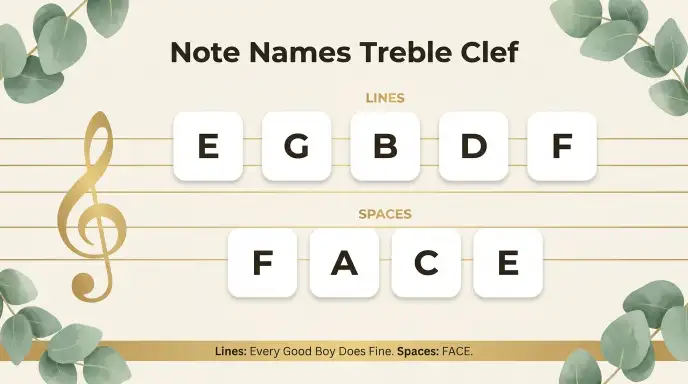
Note names treble clef are simple once you see the pattern. The five lines, from bottom to top, are E, G, B, D, and F. The four spaces, from bottom to top, are F, A, C, and E, and they spell the word FACE.
This guide also covers landmark notes, ledger lines, sharps and flats, and a quick quiz.
If you play piano, violin, flute, or sing, this staff is in front of you every day. Many beginners try to memorize nine notes at once, and that is why reading feels slow. This guide gives you two memory tricks, landmark notes for fast reading, ledger lines above and below the staff, and a quiz at the end to check yourself.
Short Answer: Note Names Treble Clef?
Lines, bottom to top: E, G, B, D, F. Spaces, bottom to top: F, A, C, E.
The fast trick is simple. Learn the G line, learn middle C, and count by steps from the nearest landmark. You never need to count from the bottom line again.
What Is the Treble Clef?
The treble clef is also called the G clef. Its curl wraps around the second line from the bottom of the staff, the note G above middle C.
The staff has five lines and four spaces. Each position has one letter name.
The Musical Alphabet
Notes use only seven letters: A, B, C, D, E, F, and G. After G, the alphabet starts again at A.
Note Names on the Lines
The five lines, from bottom to top, are E, G, B, D, and F. Read them upward, never downward.
| Line (bottom to top) | Note |
| Line 1 | E |
| Line 2 | G |
| Line 3 | B |
| Line 4 | D |
| Line 5 | F |
The EGBDF Mnemonic
Most beginners remember the lines with a sentence. Each word starts with a line note, in order: “Every Good Boy Does Fine.”
Other versions work the same way: “Every Good Boy Deserves Fudge” and “Every Good Boy Deserves Football.” Pick one you will remember.
Note Names in the Spaces
The four spaces, from bottom to top, are F, A, C, and E. Together they spell the word FACE.
| Space (bottom to top) | Note |
| Space 1 | F |
| Space 2 | A |
| Space 3 | C |
| Space 4 | E |
FACE in the Space
Say the phrase “FACE in the space” and you will never forget it. The first space is F, the second is A, the third is C, and the fourth is E.
The Full Ladder: All Nine Staff Notes in Order
Together, lines and spaces give nine notes, read from bottom to top.
| Position (bottom to top) | Note |
| Line 1 | E |
| Space 1 | F |
| Line 2 | G |
| Space 2 | A |
| Line 3 | B |
| Space 3 | C |
| Line 4 | D |
| Space 4 | E |
| Line 5 | F |
Steps and Skips
This ladder gives you the two moves in music reading. A step moves from a line to the next space, or from a space to the next line.
A skip moves from one line to the next line, or from one space to the next space. It jumps over one letter.
How to Read Any Treble Note in 4 Steps
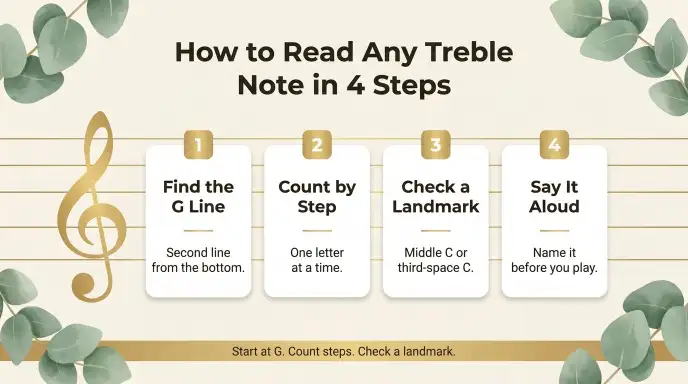
Step 1: Find the G Line
Start from the second line from the bottom. That is G, where the treble clef curls.
Step 2: Count by Step or Skip
Move from G toward your note, one position at a time, saying each letter as you go. Remember that the alphabet wraps from G back to A.
Step 3: Check a Landmark
Compare your answer with a landmark note you know well. Landmarks catch small counting slips.
Step 4: Say It Aloud
Say the note name out loud before you play or sing it. With practice, this whole method takes only a second.
Landmark Notes That Speed You Up
Landmark notes are notes you recognize at a glance.
The G line is the first landmark: the second line from the bottom, marked by the clef itself.
The third space C is another useful landmark. Middle C is the most famous landmark of all, and it sits just below the staff on its own ledger line.
Use landmarks to read faster: one step above the G line is A, and one step below the third space C is B.
Ledger Lines Below the Staff
Notes lower than the bottom line need extra short lines, called ledger lines. They extend the staff downward, one line at a time.
| Position (from the staff downward) | Note |
| Space just below the bottom line | D |
| First ledger line below the staff | C (middle C) |
| Space below that line | B |
| Second ledger line below the staff | A |
How to Count Ledger Lines Below
Start at the bottom line, which is E. Step down one space to D, then down again to the first ledger line, which is C, known as middle C.
Keep stepping down to B, then to the second ledger line, which is A. Never guess a ledger note.
Ledger Lines Above the Staff
High notes work the same way, but upward. The top line is F, so the first position above it is a space.
| Position (from the staff upward) | Note |
| Space just above the top line | G |
| First ledger line above the staff | A |
| Space above that line | B |
| Second ledger line above the staff | C |
How to Count Ledger Lines Above
Start at the top line, which is F. Step up one space to G, then up again to the first ledger line, which is A. Keep stepping up to B, then to the second ledger line, C.
Each new line or space is one letter forward in the alphabet.
Sharps and Flats in One Minute
Sharps and flats are called accidentals. A sharp raises a note by a half step, and a flat lowers one by a half step.
An accidental does not change which line or space the note sits on. A sharp on the second line is still G sharp, and a flat on the third space is still C flat.
Treble Clef vs Bass Clef
The treble clef covers higher sounds, and the bass clef covers lower sounds. Together they form the grand staff used for piano music.
The bass clef lines, from bottom to top, are G, B, D, F, and A. A common mnemonic is “Good Boys Deserve Fudge Always.”
Its spaces, from bottom to top, are A, C, E, and G. A common mnemonic is “All Cows Eat Grass.”
| Clef | Lines (bottom to top) | Spaces (bottom to top) |
| Treble | E, G, B, D, F | F, A, C, E |
| Bass | G, B, D, F, A | A, C, E, G |
Which Instruments Use the Treble Clef?
The treble clef is used for higher sounds. It is the main clef for the violin, flute, clarinet, and trumpet, and for higher voices, sopranos and altos.
Piano players use both clefs: the right hand plays treble notes, and the left hand plays bass notes.
Common Mistakes Beginners Make
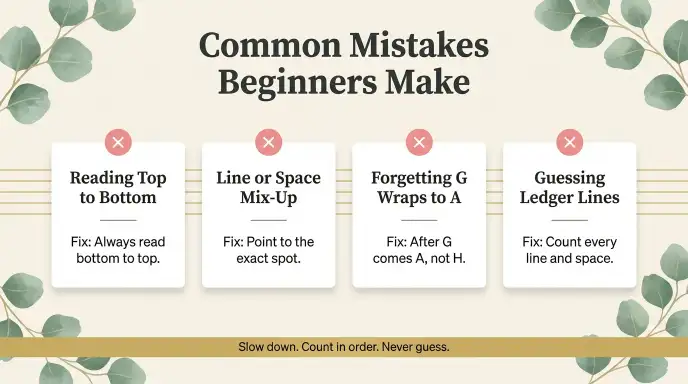
Reading Top to Bottom
The staff is always read from bottom to top. Drill the upward order: lines E, G, B, D, F and spaces F, A, C, E.
Mixing Up a Line and Its Neighbor Space
A line note and the space right next to it are only one step apart. Slow down on close pairs, and point to the exact line or space before you name the note.
Forgetting the Alphabet Wraps at G
After G comes A again, not H. When you count past G, restart at A.
Guessing Ledger Lines
Ledger lines look small and easy to rush. Count each line and space in order, from the staff outward.
Easy Ways to Practise
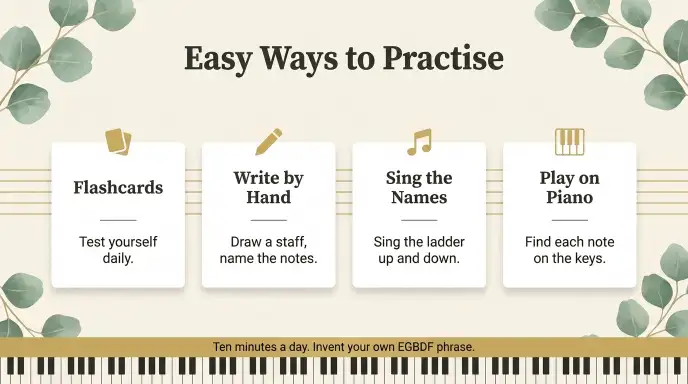
Ten minutes a day builds fast, lasting recall.
Flashcards are the classic tool: write a note on one side and its letter on the other, then shuffle and test yourself. Writing notes out by hand also helps. Draw a staff, fill it with notes, then name each one.
Singing the letter names works well too: sing the ladder from the bottom line to the top line and back down. If you have a piano or keyboard, find each note on the keys as you name it.
Finally, invent your own EGBDF phrase. A sentence that makes you laugh is easier to remember than a borrowed one.
Practice Quiz
Try these eight quick questions. Answers are in brackets. Cover the answers, name each note, then check yourself.
- What note is on the bottom line of the treble staff? (E)
- What note is on the second line from the bottom? (G)
- What note is in the first space of the treble staff? (F)
- What word do the treble spaces spell? (FACE)
- What note is on the first ledger line below the staff? (middle C)
- What note is in the third space of the treble staff? (C)
- What note is on the top line of the treble staff? (F)
- What note is on the first ledger line above the staff? (A)
How did you do? Eight out of eight means the staff is yours, and five to seven means you are close. Go back to the landmark notes and try the quiz again tomorrow.
Key Takeaways
- The treble clef is the G clef. Its curl marks the G line.
- Lines, bottom to top: E, G, B, D, F. Remember “Every Good Boy Does Fine.”
- Spaces, bottom to top: F, A, C, E. Remember “FACE in the space.”
- The full ladder runs E, F, G, A, B, C, D, E, F.
- A step moves one letter. A skip jumps over one letter.
- Ledger lines extend the staff. Count each line and space in order, never guess.
- Middle C is the first ledger line below the staff. It links treble and bass clefs.
- Sharps raise a note by a half step. Flats lower it by a half step.
- Treble clef serves higher sounds: violin, flute, clarinet, trumpet, soprano, alto, and the piano right hand.
FAQs About Note Names Treble Clef
1. What are the note names on the treble clef lines?
The treble clef lines, from bottom to top, are E, G, B, D, and F. The classic mnemonic is “Every Good Boy Does Fine,” with each word starting on the matching line note, and other versions like “Every Good Boy Deserves Fudge” work the same way. Read the lines upward, never downward.
2. What are the note names in the treble clef spaces?
The treble clef spaces, from bottom to top, are F, A, C, and E. They spell the word FACE. The first space is F, the second space is A, the third is C, and the fourth, just below the top line, is E.
3. How do you remember EGBDF?
Use a sentence where each word starts with a line note in order. The most famous one is “Every Good Boy Does Fine,” and other popular versions are “Every Good Boy Deserves Fudge” and “Every Good Boy Deserves Football.” Pick the sentence you find easiest to recall, or invent your own.
4. What is middle C in treble clef?
Middle C is the note that sits on the first ledger line below the treble staff. It is the bridge note between the treble and bass staves on the grand staff. To find it, step down from the bottom line E to the space D, then down once more to the ledger line C.
5. What notes are on ledger lines above the treble staff?
Above the treble staff, the space just above the top line is G, and the first ledger line above the staff is A. The space above that line is B, and the second ledger line above the staff is C. Count upward from the top line F, one letter at a time.
6. What notes are on ledger lines below the treble staff?
Below the treble staff, the space just below the bottom line is D, and the first ledger line below the staff is C, known as middle C. The space below that line is B, and the second ledger line below the staff is A. Count downward from the bottom line E, one letter at a time.
7. How is the treble clef different from the bass clef?
The treble clef covers higher sounds and the bass clef covers lower sounds. Treble lines are E, G, B, D, F and treble spaces are F, A, C, E, while bass lines are G, B, D, F, A and bass spaces are A, C, E, G. Both clefs use the same seven letter alphabet and the same step and skip logic.
8. Do sharps and flats change a note name?
Sharps and flats change the pitch, but the base letter stays tied to its line or space. A sharp raises a note by a half step, so a sharp on the G line is called G sharp, and a flat lowers a note by a half step, so a flat on the C space is called C flat. The symbol sits just before the note.
9. How can I learn treble clef notes fast?
Practise a little every day with flashcards, hand drawn staves, and singing the letter names. Learn landmark notes like the G line and middle C, then count short hops from them instead of counting from the bottom each time. Find each note on a piano keyboard if you can.
Conclusion
Treble clef notes follow one simple ladder: lines E, G, B, D, F and spaces F, A, C, E. Once you know that ladder, no note on the staff can surprise you. Landmark notes like the G line and middle C make reading fast, and ledger line counting covers every note above and below the staff.
Start with the two mnemonics, then practise the ladder a little every day. Use the quiz above to check yourself, and invent your own EGBDF phrase if the classic one does not stick. When treble notes feel easy, the bass clef is your natural next step.
✨More Name Inspiration!
Other Names for White: Baby Names That Mean White

Hi, I’m Aaliyah Morgan, a writer at NameNexa. I’ve always loved discovering names and the stories, meanings, and ideas behind them. At NameNexa, I share name ideas that are unique, meaningful, and easy to connect with, from baby names and cultural names to creative naming inspiration.