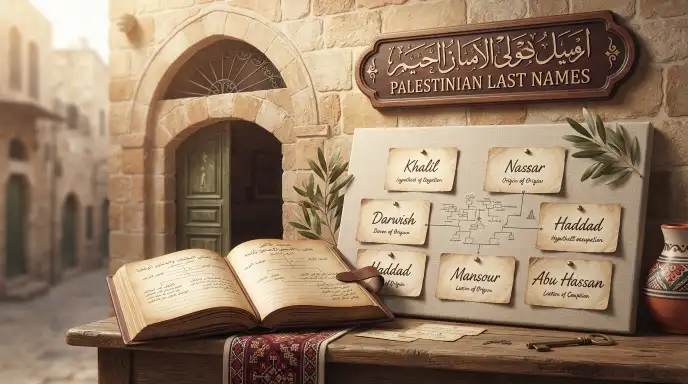
Palestinian last names often carry clues about family history, places of origin, occupations, ancestry, and community life. Some are linked to towns and villages, while others developed from occupations, personal names, nicknames, or family lineages. Because naming traditions vary across Palestine and its communities, the same surname may have different spellings or historical explanations.
Common Palestinian Last Names
Well Known Family Names
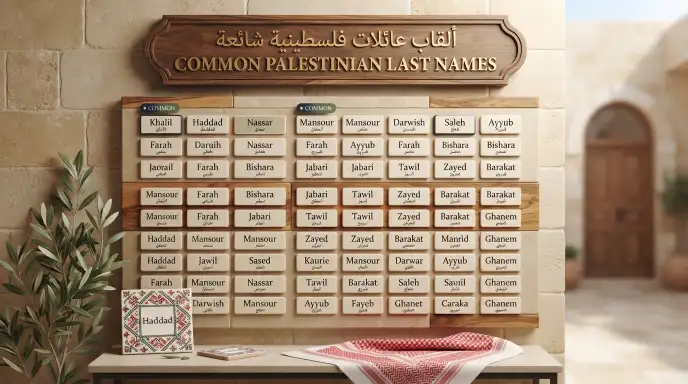
Some Palestinian surnames are widely recognized across different Palestinian communities. Examples include:
- Abu Ghazaleh
- Abu Sneineh
- Al Hout
- Barakat
- Darwish
- Haddad
- Khalil
- Kattan
- Nassar
- Qattan
- Qasem
- Sabbagh
- Shaheen
- Shawish
- Tannous
The exact history of an individual family should not be assumed from the surname alone. Family records and local history can provide more specific information.
Palestinian Last Names and Their Origins
Place Based Surnames
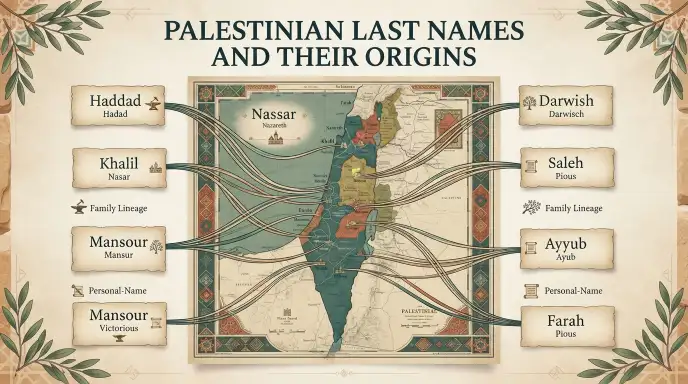
A number of Palestinian family names are connected with geographic places. A surname may preserve an association with a town, village, region, or an earlier family home.
This type of naming can be especially meaningful because Palestinian family and place identities have often been closely connected. Historical research also shows the importance of place and family names in Palestinian social memory.
Examples of place related surnames or forms include names such as:
- Al Maqdisi : associated with Jerusalem, historically known as al Quds
- Al Ghazzawi : associated with Gaza
- Al Khalili : associated with Hebron, known in Arabic as al Khalil
- Al Nabulsi : associated with Nablus
These forms can indicate an association with a place, but they do not automatically prove that every person with the surname has the same family origin.
Occupational Surnames
Some Arabic family names developed from occupations or trades.
Haddad, for example, is an Arabic surname associated with a blacksmith.
Sabbagh is associated with dyeing or a dyer.
Najjar is associated with carpentry or a carpenter.
Khayyat is associated with sewing or a tailor.
Occupational surnames can appear in many Arab communities, so they should not automatically be treated as exclusively Palestinian.
Palestinian Surnames by Region
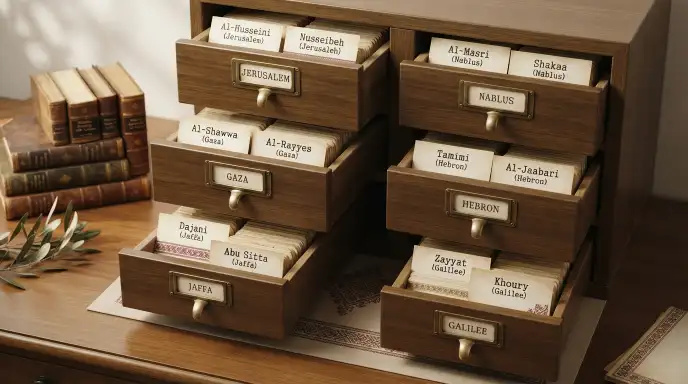
Jerusalem and Surrounding Areas
Jerusalem has a long history of families with names connected to the city and its religious, cultural, and commercial life.
Al Maqdisi is a well known geographical form associated with Jerusalem.
Other family names found among Palestinian Jerusalem communities include:
- Khalidi
- Nusseibeh
- Dajani
- Nashashibi
- Jarallah
Individual family histories can be much more detailed than the meaning suggested by the surname.
Hebron
Hebron is known in Arabic as al Khalil, and some surnames reflect an association with the city.
Al Khalili is a geographical surname meaning someone associated with Hebron.
Families in the Hebron area also have a wide range of surnames connected to lineage, villages, occupations, and local history.
Nablus
Nablus has its own long standing family networks and naming traditions.
Al Nabulsi is a well known geographical surname associated with Nablus.
Other surnames may preserve connections to villages or communities around the Nablus area.
Gaza
Gaza has a rich history of families with different regional, tribal, occupational, and geographical backgrounds.
Al Ghazzawi is a geographical form associated with Gaza.
The region’s family names also reflect connections with surrounding towns, villages, and broader Arab naming traditions.
Palestinian Last Names With Meanings
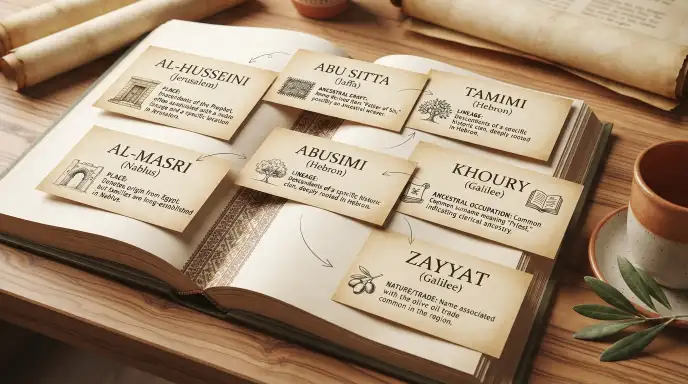
Names Connected to Occupations
Several surnames have meanings based on traditional work:
- Haddad : blacksmith
- Najjar : carpenter
- Sabbagh : dyer
- Khayyat : tailor
- Farran : baker or oven worker
- Attar : perfumer or seller of fragrances
These occupational terms are also found beyond Palestine because Arabic occupational surnames are shared across the wider region.
Names Connected to Personal Names
Some family names developed from given names or ancestral names.
For example, a family surname may preserve the name of an earlier ancestor. In Arabic naming traditions, forms using ibn, bin, or Abu can also indicate relationships or family connections.
Over generations, such identifiers can become established family names.
Names Connected to Places
Geographical surnames can identify a connection with a particular location.
Examples include:
- Al Maqdisi : Jerusalem
- Al Nabulsi : Nablus
- Al Ghazzawi : Gaza
- Al Khalili : Hebron
These names are useful clues, but a surname alone cannot tell the complete story of a family.
Palestinian Christian Last Names
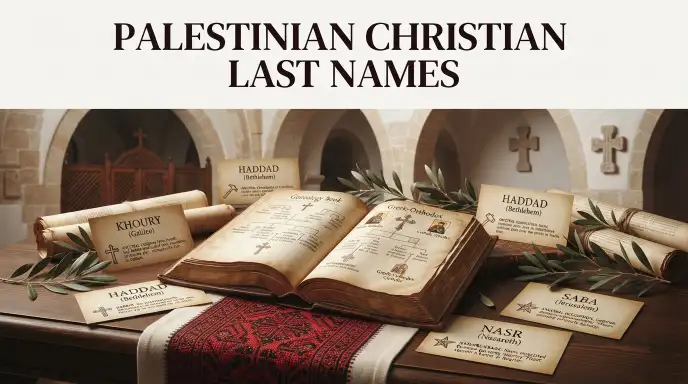
Christian Family Names
Palestinian Christians have long been part of the region’s communities, particularly in places such as Jerusalem, Bethlehem, Ramallah, Nazareth, and other towns.
Their surnames can be Arabic in form and may come from:
- Occupations
- Ancestors
- Villages
- Cities
- Religious traditions
- Nicknames
- Family lineages
Some Palestinian Christian surnames are also found among Christian communities elsewhere in the Levant.
Examples
Examples of Palestinian Christian family names include:
- Tannous
- Khoury
- Haddad
- Nassar
- Kattan
- Saba
- Salameh
- Qattan
A surname alone should not be used to determine someone’s religion. The same family name may appear among different communities.
Palestinian Muslim Last Names
Common Naming Patterns
Palestinian Muslim families use a wide range of Arabic surnames.
These can reflect:
- An ancestor’s name
- A profession
- A place
- A tribal or extended family connection
- A nickname
- Religious or cultural history
Names such as Khalil, Darwish, Nassar, Qasem, and Barakat can be found in Palestinian communities.
However, many of these surnames are also used throughout the Arab world.
Palestinian Family Names and Naming Traditions
The Importance of Family
Family identity has an important place in Palestinian social life. Research on Palestinian family names specifically examines how surnames reflect culture and everyday life.
A surname may connect an individual with an extended family, ancestral village, occupation, or historical community.
This is one reason a family name can carry meaning beyond its dictionary definition.
Family Names and Place
Place can be especially important when studying Palestinian surnames.
A family may preserve the name of a village or city even after generations of movement. Historical writing on Palestinian families also shows how people remember places through family names and stories.
This makes surnames valuable clues when researching family history.
Palestinian Last Names for Characters
Historical Characters
If you are writing a historical story, choose a surname that fits the character’s time and location.
A Jerusalem character might have a Jerusalem linked surname, while a character from Nablus could use a surname associated with that region.
Research the period before assigning a name. Modern spellings and family name usage may not always match earlier records.
Fictional Characters
For fictional characters, you can choose from documented Palestinian surnames such as:
- Khalidi
- Nusseibeh
- Dajani
- Nassar
- Barakat
- Haddad
- Kattan
- Qattan
- Khoury
- Tannous
Avoid assigning a surname a specific village or religious identity unless your story has a factual basis for doing so.
Unique Palestinian Last Names
Less Familiar Choices
If you want something less common to English speaking readers, consider:
- Al Maqdisi
- Al Nabulsi
- Al Khalili
- Al Ghazzawi
- Nusseibeh
- Dajani
- Nashashibi
- Khalidi
- Tannous
- Qattan
Some of these names are geographical, while others are established family names.
Why They Stand Out
Arabic surnames can look different when transliterated into English.
For example, the same Arabic surname may appear with different spellings because Arabic sounds do not always have one fixed English equivalent.
This can create forms such as Kattan, Qattan, Qatan, or Cattan in different records. A discussion of the surname Kattan specifically notes several Latin spellings and explains that the name can occur across different religious communities.
How Palestinian Last Names Are Spelled
Arabic to English Transliteration
There is no single universal way to write every Arabic surname in Latin letters.
For example:
Qattan
may also appear as:
Kattan, Qatan, or Cattan.
The spelling can depend on family preference, country, historical documents, or the system used to transliterate Arabic.
Why Spellings Differ
Older documents may use spellings that differ from modern records.
Migration can also introduce another spelling. A family may keep the spelling used in passports, immigration documents, school records, or other official paperwork.
For genealogy research, it is useful to check several spelling variations.
How to Research a Palestinian Family Name
Start With Family Records
If you are researching your own family history, begin with documents already held by relatives.
Useful sources can include:
- Birth certificates
- Marriage records
- Old passports
- Family documents
- Land records
- Cemetery records
- Immigration papers
- Oral family histories
Write down different spellings instead of choosing one version too early.
Trace the Place Connection
If a surname appears to be geographical, identify the place connected with it.
A village or city association can help narrow the search.
Historical sources can then provide additional context about the family and the area.
Compare Multiple Sources
A surname website may give only one possible explanation.
For deeper research, compare family documents with historical records, academic research, and reliable local sources.
This is especially important for surnames with several possible origins.
Frequently Asked Questions
Q1. What is the most popular last name in Gaza?
There is no single reliably established “most popular” surname for Gaza. Common Palestinian family names include Abu Hmeid, Al Masri, Shawa, Doghmush, and Al Ghoul, though prevalence varies by area and family.
Q2. What is a very Palestinian name?
Names strongly associated with Palestinian culture include Yasser, Mahmoud, Rami, Lina, Leila, Yasmeen, and Palestine.
Q3. What are some famous Palestinian families?
Well known Palestinian family names include Al Husseini, Nashashibi, Khalidi, and Abu Dis, each associated with different historical or geographic communities.
Q4. What is a typical Israeli surname?
Common Israeli surnames include Cohen, Levi, Mizrahi, Peretz, Biton, and Shapira. Israeli surnames reflect Jewish communities from many different regions.
Q5. What are Palestinian last names?
Examples of Palestinian surnames include Husseini, Khalidi, Nassar, Masri, Shawa, Barakat, and Qasem.
Q6. Can Jews marry Muslims in Israel?
Generally, a Jewish Muslim marriage cannot be performed as a religious marriage inside Israel because marriage is administered by recognized religious authorities. Couples can marry abroad, and such marriages can be registered in Israel.
Q7. Do Jews accept LGBT?
Jewish views on LGBT people vary considerably by denomination and community. Reform and Conservative Judaism generally recognize same sex relationships and marriage, while Orthodox Judaism generally follows traditional prohibitions on same sex sexual relationships.
Q8. Who is forbidden to marry in Islam?
Islam prohibits marriage with certain close relatives, including mothers, daughters, sisters, aunts, nieces, mothers through nursing, daughters through nursing, mothers in law, and certain other relationships listed in Qur’an 4:23.
Q9. Can Jews kiss before marriage?
There is no single answer for all Jews. Jewish practice varies by denomination and level of religious observance; some Orthodox communities discourage physical intimacy between unmarried as people, while more liberal Jewish communities generally do not prohibit kissing before marriage.
Final Thoughts
Palestinian last names can preserve connections to family, place, work, ancestry, and community. Names such as Al Maqdisi, Al Nabulsi, Al Khalili, Haddad, Kattan, Nassar, and Khalidi show some of the different patterns found in Palestinian naming.
If you are researching a specific surname, treat its meaning as a starting point rather than the complete family history. Documents, local records, and family stories can reveal details that a surname alone cannot provide.
💎 Discover the Beauty of Names:
Names Meaning Chaos: Unique & Powerful Names
Hi, I’m Aaliyah Morgan, a writer at NameNexa. I’ve always loved discovering names and the stories, meanings, and ideas behind them. At NameNexa, I share name ideas that are unique, meaningful, and easy to connect with, from baby names and cultural names to creative naming inspiration.