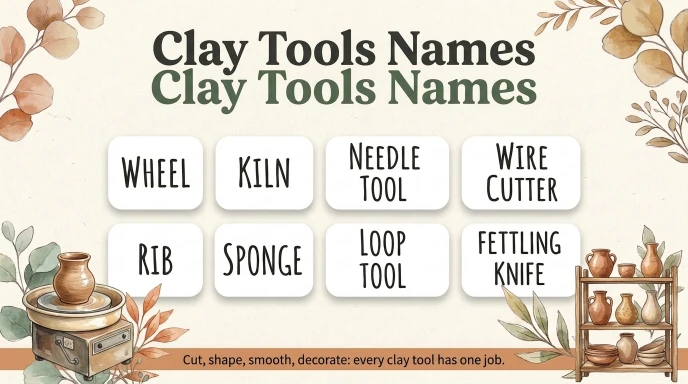
Clay tools names can feel confusing at first. A loop tool, a ribbon tool, and a trimming tool look similar, yet each one does a different job. This guide names every common clay tool in plain words and shows which one to pick for each job.
If you are starting pottery, sculpting, or polymer clay work, tool names matter. Shops, videos, and classes all use these names.
This guide covers pottery, hand building, sculpting, and polymer clay tools, plus a starter kit and cleaning tips.
Short Answer: Clay Tools Names
Start with seven tools. They cover most beginner jobs.
| Starter Tool | Main Job |
| Needle tool | Score, trim, and check thickness |
| Wire cutter | Slice clay and lift pots off the wheel |
| Wooden rib | Smooth and shape walls |
| Metal rib | Firm curves and refine shape |
| Loop tool | Trim and hollow leather hard clay |
| Trimming tool | Turn a foot ring at the wheel |
| Sponge | Wet, smooth, and lift water |
Shaping Tools
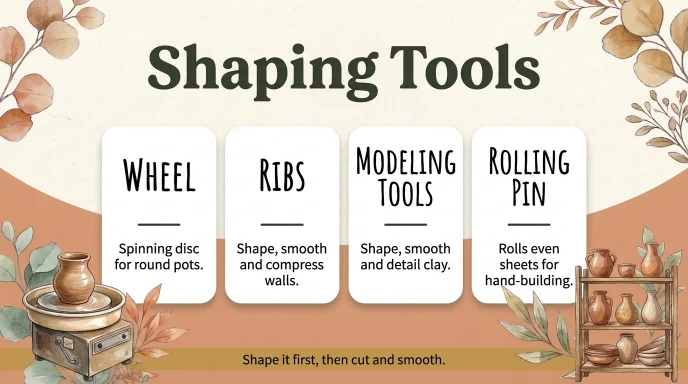
Shaping tools form clay into the shape you want.
| Tool | What It Does |
| Pottery wheel | Spinning disc for shaping round pots by hand |
| Ribs | Flat curved tools that shape, smooth, and compress clay walls |
| Modeling tools | Wooden and metal tools that shape, smooth, and detail clay |
| Rolling pin | Rolls clay into even sheets for hand building |
| Slab roller | Rolls large even clay slabs for hand building |
| Extruder | Pushes clay through shaped dies for coils, handles, and strips |
| Bats | Flat discs that fit the wheel head and carry a thrown piece safely |
The Pottery Wheel
The pottery wheel is the heart of wheel throwing. The wheel head spins while your hands shape bowls, cups, and vases. A wheel is a big buy, so many beginners start with hand building first.
Ribs: The Shaper in Your Hand
A rib is a flat tool with a curved edge. Press it against a clay wall to shape and smooth it. A metal rib firms curves, while a wooden or rubber rib finishes the surface.
Cutting and Trimming Tools
Cutting tools divide clay and remove extra clay.
| Tool | What It Does |
| Needle tool | Long needle in a handle; scores joins, trims rims, checks thickness, pops air bubbles |
| Wire clay cutter | Wire with handles; slices clay from a block and lifts pots off the wheel head |
| Fettling knife | Flat blade; cuts, trims, and cleans edges |
| Loop tool | Metal loop on a handle; trims and hollows leather hard clay |
| Ribbon tool | Flat metal ribbon shape; carves fine lines and details |
| Trimming tool | Turns a foot ring and removes weight from a leather hard base at the wheel |
Loop Tool, Ribbon Tool, and Trimming Tool: Three Different Tools
Beginners often mix up these three tools. A loop tool scoops clay away when you trim or hollow a piece. A ribbon tool carves fine lines and details, while a trimming tool turns a pot base into a neat foot ring at the wheel.
The Needle Tool and the Wire Cutter
The needle tool scores joins so they hold, trims rims, checks wall thickness, and pops air bubbles. The wire cutter slices clean pieces from a block of clay and lifts a thrown pot off the wheel head.
Smoothing and Finishing Tools
Smoothing tools give clay a clean surface.
| Tool | What It Does |
| Sponge | Wets clay, lifts water from inside a pot, and smooths surfaces |
| Chamois | Soft leather cloth that smooths wheel thrown rims |
| Wooden rib | Smooths and finishes walls |
| Rubber rib | Smooths and finishes walls with a soft edge |
| Metal rib | Firms curves and refines the shape |
Sponge and Chamois
A sponge wets clay, wipes surfaces smooth, and lifts extra water from inside a thrown pot. A chamois is a soft leather cloth that smooths a spinning rim into a clean edge.
Measuring and Wheel Tools
Measuring tools help parts fit together.
| Tool | What It Does |
| Calipers | Measure diameters so lids and matching parts fit |
| Banding wheel | Small turntable for turning a piece by hand while decorating or hand building |
| Kiln | Oven that fires clay at high heat to harden it |
Calipers and the Banding Wheel
Potter’s calipers look like large tongs with curved tips. Set them to a pot opening, then check the lid against the same setting, so the lid fits. A banding wheel is different: it is a small turntable you spin by hand while you paint or carve.
The Kiln
The kiln is the oven that turns soft clay into hard pottery. Clay is usually fired twice: first a bisque firing hardens it, then a glaze firing melts glaze onto it. A kiln is studio equipment, not a first buy.
Decorating Tools
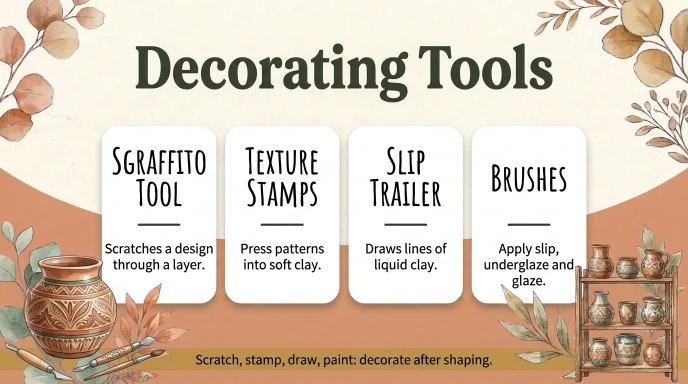
Decorating tools add pattern, texture, and color.
| Tool | What It Does |
| Sgraffito tool | Fine point for scratching a design through a surface layer |
| Texture stamps | Press patterns into soft clay |
| Texture rollers | Roll patterns across soft clay |
| Slip trailer | Bottle with a fine nozzle that draws lines of liquid clay |
| Brushes | Apply slip, underglaze, and glaze |
Sgraffito, Stamps, and Slip Trailing
Sgraffito means scratching a design through a surface layer to show the clay beneath. Stamps press a ready pattern into soft clay, rollers roll a repeating pattern, and a slip trailer draws raised lines of liquid clay. Brushes apply slip, underglaze, and glaze in smooth coats.
Hand Building Tools
Hand building means making pottery without a wheel.
| Tool | What It Does |
| Rolling pin | Rolls clay into even sheets |
| Slab roller | Rolls large even clay slabs |
| Extruder | Pushes clay through dies for coils, handles, and strips |
| Banding wheel | Turns a piece by hand for decorating and building |
| Ribs | Shape and smooth slab walls |
| Modeling tools | Shape, smooth, and detail hand built forms |
| Needle tool | Scores joins and trims edges |
| Sponge | Wets and smooths surfaces |
Yes, You Can Make Pottery Without a Wheel
Many beginners think a wheel is required, but it is not. Roll a slab, cut it to shape, and join the edges with scored and slipped seams. A banding wheel helps you turn the piece while you work.
Sculpting Tools
Sculpting tools shape clay into figures and models.
| Tool | What It Does |
| Modeling tools | Wooden and metal tools that shape, smooth, and detail sculpted clay |
| Loop tool | Trims and hollows firm clay |
| Ribbon tool | Carves fine lines and small details |
| Armature wire | Wire frame inside a sculpture for support |
Armature Wire
An armature is a wire frame inside a sculpture. It holds the shape up while you add clay around it. It matters most for tall or thin parts, like arms and necks, that would sag alone.
Polymer Clay Tools
Polymer clay hardens in a home oven, not a kiln, so it needs its own tool set.
| Tool | What It Does |
| Pasta machine | Conditions polymer clay and rolls it into even sheets |
| Acrylic roller | Rolls polymer clay flat on a work surface |
| Tissue blade | Long flexible blade for clean slices |
| Ball stylus | Dotting tool for shaping and small details |
| Silicone shapers | Soft tips for smoothing and shaping |
| Cutters and molds | Cut shapes and press repeat forms |
| Fine sandpaper | Smooths finished polymer clay pieces |
The Polymer Clay Basics
A pasta machine kneads stiff clay and rolls it into smooth even sheets. An acrylic roller does the same job on a smaller scale for less money. A tissue blade slices clean cuts, a ball stylus makes dots and curves, and fine sandpaper smooths a cured piece.
Tool by Job Quick Guide
If you know the job, this table names the tool.
| Job | Use This Tool |
| Cut clay from a block | Wire cutter or fettling knife |
| Join two pieces | Needle tool for scoring, plus slip |
| Shape a wheel thrown wall | Ribs |
| Smooth a rim | Chamois or sponge |
| Trim a leather hard base | Trimming tool or loop tool |
| Hollow a form | Loop tool |
| Carve fine lines | Ribbon tool or sgraffito tool |
| Add a pattern | Texture stamps or texture rollers |
| Draw with liquid clay | Slip trailer |
| Check a lid fit | Calipers |
| Roll an even slab | Rolling pin or slab roller |
| Make coils and strips | Extruder |
| Support a sculpture | Armature wire |
| Slice polymer clay cleanly | Tissue blade |
Beginner Starter Kit: What to Buy First
Buy the seven starter tools first, and add the rest as your work grows.
| Buy First | Can Wait |
| Needle tool | Extruder |
| Wire cutter | Slab roller |
| Wooden rib | Pug mill |
| Metal rib | Spray gun |
| Loop tool | Specialty stamps |
| Trimming tool | Extra ribbon tools |
| Sponge | Extra modeling tools |
A pug mill mixes and de airs recycled clay in a shared studio. It is not a beginner buy.
How to Clean and Care for Clay Tools
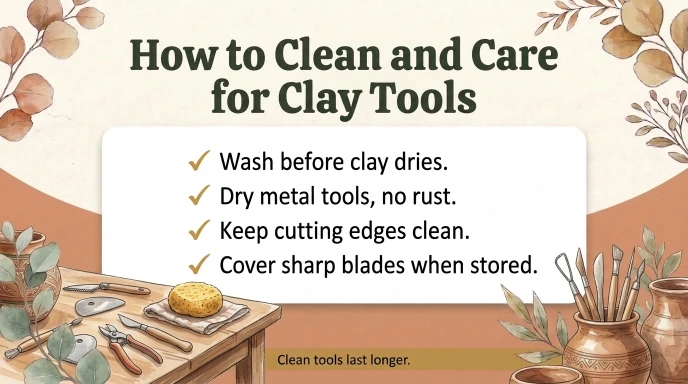
Wash tools after use, before clay dries on them. Dried clay dulls cutting edges. Dry metal tools so they do not rust, and store sharp tools with blades covered.
FAQs About Clay Tools Names
1. What tools do I need to start pottery?
You need seven basic tools to start pottery: a needle tool, a wire cutter, a wooden rib, a metal rib, a loop tool, a trimming tool, and a sponge. These seven cover cutting, shaping, trimming, and smoothing for most beginner projects. Add decorating tools and calipers later, once you know which pottery you enjoy most.
2. What is a loop tool used for?
A loop tool trims and hollows clay that has firmed up to leather hard. The metal loop scoops clay away in controlled strokes, which thins walls and carves out forms. Potters also use it to trim the outside of a piece and shape curved surfaces. Keep the loop edge clean, so it cuts smoothly instead of dragging.
3. What is the difference between a loop tool and a ribbon tool?
A loop tool has a loop of metal wire, and it scoops clay away when you trim or hollow a piece. A ribbon tool has a flat ribbon of metal, and it carves fine lines and small details into the surface. Use the loop tool to remove clay, and the ribbon tool to draw detail. They look similar, but their jobs are different.
4. What is a fettling knife used for?
A fettling knife is a flat blade used to cut, trim, and clean clay edges. Potters use it to cut slabs to size, trim uneven edges, and clean seams where pieces join. It also cuts soft clay cleanly when a wire cutter feels too loose. Keep the blade clean and dry, so it stays sharp and does not rust.
5. What is a rib in pottery?
A rib is a flat tool with a curved edge that shapes, smooths, and compresses clay walls. Metal ribs firm curves and give a crisp shape, while wooden ribs and rubber ribs smooth and finish the surface. Potters use ribs on the wheel and in hand building. One metal rib and one wooden rib suit most beginners.
6. What is the difference between a pottery wheel and a banding wheel?
A pottery wheel is a powered spinning disc used to throw round pots by hand. A banding wheel is a small turntable you spin by hand, and it turns a piece slowly while you work. Use the pottery wheel to shape pots, and the banding wheel to paint, carve, or build without touching the wet surface.
7. What tools do I need for polymer clay?
Polymer clay needs a small tool set: a pasta machine or acrylic roller for sheets, a tissue blade for clean slices, a ball stylus for dots and curves, silicone shapers for smoothing, and cutters or molds for repeat shapes. Fine sandpaper finishes a cured piece. You do not need a wheel or a kiln, since polymer clay hardens in a home oven.
8. Can I make pottery without a wheel?
Yes, you can make pottery without a wheel. Hand building uses slabs, coils, and pinch pots, shaped by hand with a rolling pin, ribs, a banding wheel, and modeling tools. Many potters start this way, since it needs little equipment and teaches how clay behaves. A wheel helps for round pots, but it is not required.
9. How do I clean clay tools?
Wash clay tools after use, before clay dries on them, since dried clay dulls cutting edges and is hard to remove. Rinse with water, wipe each tool clean, and dry metal tools right away so they do not rust. Keep loop and ribbon edges clean for smooth cuts, and store sharp tools with blades covered.
Conclusion
Clay tools names stop feeling strange once you link each name to one job. A wire cutter cuts, a rib shapes, a loop tool hollows, a chamois smooths rims, and calipers make lids fit. The seven starter tools cover most beginner work, and this guide names the exact tool for special jobs, from sgraffito to polymer clay sheets.
Start with the starter kit and learn each tool by using it. Add new tools only when a project asks for them. Your next step is simple: pick one small project and make something with your own hands.
🦋 Beyond Names:
Baby Chick Names: Cute, Funny and Sweet Ideas

Hi, I’m Aaliyah Morgan, a writer at NameNexa. I’ve always loved discovering names and the stories, meanings, and ideas behind them. At NameNexa, I share name ideas that are unique, meaningful, and easy to connect with, from baby names and cultural names to creative naming inspiration.