Spanish names offer much more than a single naming style. Some feel classic and traditional, while others are short, modern, nature inspired, literary, or strongly connected with Spanish and Latin American culture.
If you are looking for Spanish names, good starting points include Sofía, Lucía, Valentina, Alba, Carmen, Mateo, Santiago, Diego, Gabriel, and Sebastián. But “Spanish name” does not always mean a name that originated in the Spanish language. Spanish naming traditions have absorbed names and naming influences from Latin, Hebrew, Greek, Germanic languages, Arabic, Basque, and other sources.
Beautiful Spanish Girl Names
| Name | Meaning | Background |
| Sofía | Wisdom | Greek origin, widely used in Spanish |
| Lucía | Light | Latin |
| Valentina | Strong, healthy | Latin |
| Alba | Dawn | Also coincides with the Spanish word for “dawn” |
| Isabel | God is my oath | Spanish form related to Elizabeth |
| Carmen | Traditionally associated with Carmel | Strong Spanish devotional tradition |
| Clara | Bright, clear | Latin |
| Elena | Bright, shining | Greek origin |
| Estrella | Star | Spanish word/name |
| Paloma | Dove | Spanish word/name |
| Rosa | Rose | Latin/European name tradition |
| Marina | Of the sea | Latin |
| Catalina | Pure | Spanish form related to Catherine |
| Inés | Pure, chaste | Spanish form of Agnes |
| Pilar | Pillar | Strongly connected with the Spanish Marian title Nuestra Señora del Pilar |
Several of these names have meanings connected directly to Spanish vocabulary. Estrella, for example, is the Spanish word for “star,” while Alba corresponds to “dawn.” Other names have older linguistic roots and simply have a long history of use in Spanish.
Popular Spanish Boy Names
| Name | Meaning | Background |
| Mateo | Gift of God | Hebrew origin through biblical tradition |
| Santiago | Saint James | Spanish formation from santo + Yago |
| Sebastián | From Sebaste | Greek origin |
| Diego | Traditional Spanish given name; etymology is debated | Spanish |
| Alejandro | Defender of the people | Greek origin |
| Gabriel | God is my strength | Hebrew origin |
| Daniel | God is my judge | Hebrew origin |
| Javier | From a Basque place name | Spanish usage |
| Pablo | Small, humble | Latin |
| Miguel | Who is like God? | Hebrew origin |
| Carlos | Traditionally linked with “free man” | Germanic origin |
| Nicolás | Victory of the people | Greek |
| Antonio | Traditional Roman family name; exact original meaning is uncertain | Latin/Roman |
| Fernando | Traditionally associated with courageous or adventurous qualities | Germanic |
| Rafael | God has healed | Hebrew origin |
Santiago is particularly distinctive because its Spanish form developed from santo (“saint”) combined with Yago, an old Spanish form related to James.
Spanish Names That Are Especially Familiar Internationally
Some Spanish used names have become easy to recognize far beyond Spain and Latin America. Examples include:
- Sofia / Sofía
- Isabella / Isabel
- Camila
- Valentina
- Lucía
- Mateo
- Diego
- Gabriel
- Sebastián
- Santiago
It is useful to separate international popularity from popularity in Spain. They are not the same measurement.
For example, Spain’s official INE data for 2024 newborns lists Sofía as the most frequent name among newborn girls and Mateo among newborn boys. This is specifically a statistic for births registered in Spain, not a worldwide ranking of Spanish names.
Classic Spanish Names
If you want a name with a traditional feel, these choices have strong historical or cultural associations:
Girls
- María
- Carmen
- Ana
- Teresa
- Dolores
- Mercedes
- Pilar
- Rosario
- Beatriz
- Isabel
Boys
- José
- Juan
- Antonio
- Francisco
- Miguel
- Manuel
- Carlos
- Fernando
- Rafael
- Francisco Javier
Religious naming traditions have played an important role in Spanish naming history. Many traditional names were connected with saints or titles of the Virgin Mary, including Dolores, Rosario, Mercedes, Pilar, and Luz.
Unique Spanish Names
“Unique” can mean different things. A name may be uncommon, regional, historically distinctive, or simply less familiar outside Spanish speaking communities.
Some interesting choices include:
- Aitana
- Almudena
- Araceli
- Covadonga
- Estíbaliz
- Macarena
- Leyre
- Nayra
- Mar
- Azahara
- Borja
- Iker
- Íñigo
- León
- Gael
Their backgrounds are not all the same. Aitana, for example, comes from the name of a mountain range in Valencia, while Almudena ultimately comes from an Arabic word connected with a citadel. Leyre comes from a place name in Navarre, and Macarena comes from a district of Seville.
That is why it is better to describe these names individually than to claim that every distinctive Spanish name has a purely Spanish origin.
Short Spanish Names
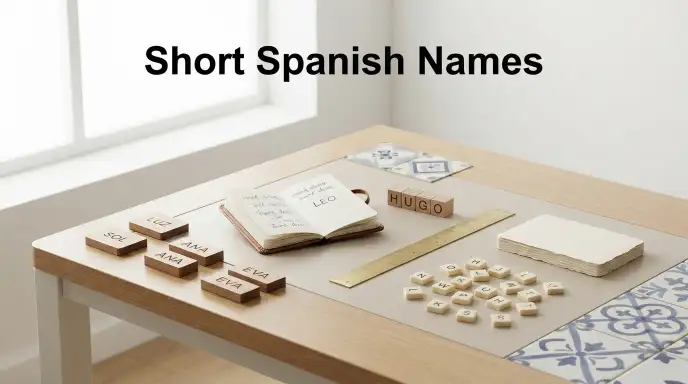
Short names can be easy to say, spell, and remember.
Girls
- Alma : “soul” is one association with the Spanish word alma
- Alba : dawn
- Luz : light
- Mar : sea
- Sol : sun
- Rosa : rose
Boys
- Leo
- Luis
- Juan
- Saúl
- Raúl
- Pau
- Hugo
Some short names are ordinary Spanish words, while others are shortened forms or names with much older origins. That distinction matters if the meaning is important to you.
Spanish Names Inspired by Nature
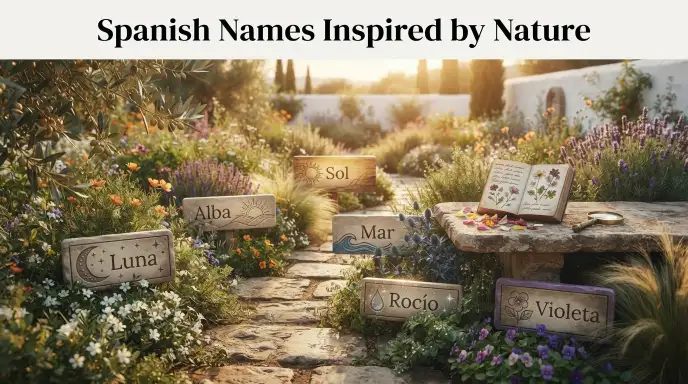
Spanish naming includes names that connect naturally with landscapes, plants, animals, light, and the sea.
- Alba : dawn
- Estrella : star
- Luz : light
- Mar : sea
- Paloma : dove
- Rosa : rose
- Azucena : Madonna lily
- Coral : coral
- Brisa : breeze
- Alondra : lark
Some are directly Spanish vocabulary words, while others entered Spanish naming through religious, literary, or older linguistic traditions. Alondra, for example, comes from the Spanish word for “lark,” while Azucena refers to the Madonna lily.
Spanish Names With Religious Roots
Spanish naming history has a strong Christian and Catholic component. Traditional examples include:
- María
- José
- Jesús
- Dolores
- Mercedes
- Rosario
- Pilar
- Consuelo
- Carmen
- Encarnación
- Asunción
- Milagros
Several are connected with Marian titles rather than being simple translations of ordinary Spanish words. For example, Mercedes comes from Nuestra Señora de las Mercedes, while Rosario is connected with Nuestra Señora del Rosario.
Spanish Names With Beautiful Meanings
If meaning is your main priority, these are useful starting points:
| Name | Meaning |
| Sofía | Wisdom |
| Lucía | Light |
| Alba | Dawn |
| Estrella | Star |
| Luz | Light |
| Paloma | Dove |
| Valentina | Strong, healthy |
| Gabriel | God is my strength |
| Rafael | God has healed |
| Alejandro | Defender of the people |
| Nicolás | Victory of the people |
| Mateo | Gift of God |
Meanings should be treated as etymological descriptions, not predictions about someone’s personality. A name meaning “strong,” for example, does not scientifically make a person strong.
Spanish Names for Characters
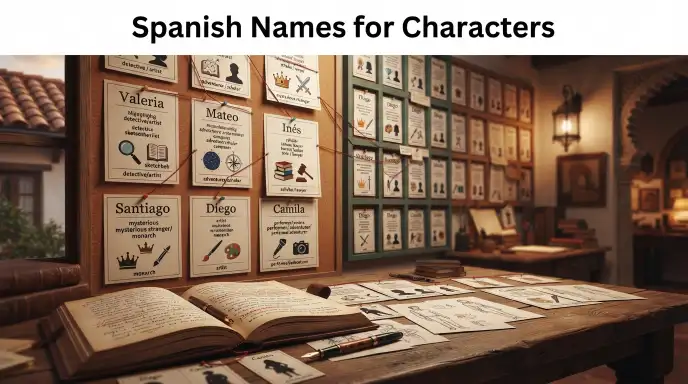
Spanish names can work especially well for fictional characters when the character’s setting, family background, age, and region are considered.
For a traditional Spanish setting, names such as Carmen, María, José, Antonio, Miguel, or Francisco may fit a different generation and social context than newer feeling choices such as Alma, Valentina, Mateo, or Gael.
For a character from a particular Spanish speaking country, research that country’s naming patterns rather than assuming that every Spanish name is equally common everywhere. Spanish speaking communities span Europe and the Americas, and regional naming traditions can differ.
How Spanish Naming Traditions Work
A Spanish name can contain more than one given name and traditionally may be followed by two surnames. A common structure is:
Given name + first surname + second surname
The traditional surname system uses the father’s paternal surname followed by the mother’s paternal surname. Naming practices and legal rules can vary by country, however, so this structure should not automatically be applied to every Spanish speaking person.
Another important point is that women in traditional Spanish naming conventions generally do not replace their surnames with a husband’s surname after marriage. Again, practices differ across the wider Spanish speaking world.
Do Spanish Names Need Accent Marks?
Some Spanish names are written with accent marks, such as Sofía, Lucía, Sebastián, Nicolás, Raúl, and Íñigo.
These marks are not simply decorative. Spanish orthographic rules govern the accentuation of proper names as well as ordinary words. The RAE specifically notes that Spanish proper names follow Spanish accentuation rules.
When writing a person’s official name, use the spelling they actually use rather than changing it based on an English language version.
How to Choose a Spanish Name
Start with the reason you need the name.
For a baby:
Consider meaning, pronunciation, family traditions, regional use, and how the full name sounds.
For a character:
Match the name to the character’s country, generation, family background, and setting.
For a pet:
Short names such as Luna, Sol, Coco, Leo, or Lola can be easy to call, although suitability depends more on personal preference than linguistic rules.
For a username or creative project:
Focus on memorability, spelling, pronunciation, and if the name has the tone you want.
If cultural authenticity matters, check if the name is actually used in the relevant Spanish speaking region rather than choosing it only because its meaning sounds appealing.
Frequently Asked Questions About Spanish Names
Q1. What are some good spa names?
Some good spa names include Serenity Spa, Pure Bliss, Velvet Wellness, Tranquil Touch, Lotus Retreat, and Eden Spa.
Q2. What is spa in beauty?
A spa is a beauty and wellness facility that offers treatments such as facials, massages, body treatments, skincare, and relaxation services.
Q3. What are the top 10 spas in the world?
There is no single official global top 10. Well known luxury spas include SHA Wellness Clinic, Chiva Som, Six Senses Spa, Clinique La Prairie, and Ananda in the Himalayas.
Q4. What is a luxury spa?
A luxury spa provides high end wellness treatments, premium facilities, personalized services, and an upscale, relaxing environment.
Q5. What are the 7 types of spas?
Seven common types are day spas, destination spas, resort/hotel spas, medical spas, wellness spas, mineral spring spas, and club spas.
Q6. What is a boutique spa?
A boutique spa is a small, specialized spa that usually focuses on personalized treatments, a distinctive atmosphere, and more individualized service.
Q7. What is spa vs massage?
A spa is a broader wellness experience that can include skincare, body treatments, and relaxation services, while a massage is one specific hands on treatment.
Q8. Do you wear clothes in a spa?
It depends on the treatment and spa. You may wear comfortable clothing, a robe, or disposable garments, while massage treatments often involve appropriate draping for privacy.
Q9. Does boutique mean luxury?
Not necessarily. Boutique means small, distinctive, or specialized; a boutique business can be luxurious, but the word itself does not guarantee luxury.
Conclusion
Spanish names cover a wide range of styles, from timeless María, Carmen, José, and Miguel to contemporary choices such as Sofía, Valentina, Mateo, and Gael. Their histories are equally varied, with influences from Latin, Hebrew, Greek, Germanic languages, Arabic, Basque, Christianity, place names, and Spanish vocabulary.
For the most meaningful choice, look beyond if a name simply “sounds Spanish.” Check its actual meaning, linguistic origin, regional use, pronunciation, spelling, and cultural context. That gives you a name that fits your purpose while respecting the tradition behind it.
Your Next Name Starts Here:
Dirty Fantasy Football Team Names: Funny & Cheeky Picks

Hi, I’m Aaliyah Morgan, a writer at NameNexa. I’ve always loved discovering names and the stories, meanings, and ideas behind them. At NameNexa, I share name ideas that are unique, meaningful, and easy to connect with, from baby names and cultural names to creative naming inspiration.